

How Do Sponges Differ From All Other Animals
Chapter 15: Diversity of Animals
Sponges and Cnidarians
Learning Objectives
By the end of this department, you will be able to:
- Depict the organizational features of the simplest animals
- Depict the organizational features of cnidarians
The kingdom of animals is informally divided into invertebrate animals, those without a backbone, and vertebrate animals, those with a backbone. Although in full general we are most familiar with vertebrate animals, the vast majority of animate being species, about 95 per centum, are invertebrates. Invertebrates include a huge diversity of animals, millions of species in near 32 phyla, which we tin can just begin to touch on here.
The sponges and the cnidarians represent the simplest of animals. Sponges announced to represent an early on stage of multicellularity in the animal clade. Although they have specialized cells for item functions, they lack true tissues in which specialized cells are organized into functional groups. Sponges are similar to what might have been the ancestor of animals: colonial, flagellated protists. The cnidarians, or the jellyfish and their kin, are the simplest creature group that displays true tissues, although they possess just 2 tissue layers.
Sponges
Animals in subkingdom Parazoa represent the simplest animals and include the sponges, or phylum Porifera ([Figure one]). All sponges are aquatic and the bulk of species are marine. Sponges alive in intimate contact with water, which plays a role in their feeding, gas exchange, and excretion. Much of the body structure of the sponge is dedicated to moving water through the trunk and so it tin can filter out food, absorb dissolved oxygen, and eliminate wastes.

The body of the simplest sponges takes the shape of a cylinder with a big central crenel, the spongocoel. Water enters the spongocoel from numerous pores in the body wall. H2o flows out through a large opening chosen the osculum ([Figure 2]). However, sponges exhibit a diversity of body forms, which vary in the size and branching of the spongocoel, the number of osculi, and where the cells that filter food from the water are located.
Sponges consist of an outer layer of flattened cells and an inner layer of cells called choanocytes separated past a jelly-like substance chosen mesohyl. The mesohyl contains embedded amoeboid cells that secrete tiny needles called spicules or protein fibers that help give the sponge its structural force. The cell body of the choanocyte is embedded in mesohyl only protruding into the spongocoel is a mesh-like collar surrounding a unmarried flagellum. The beating of flagella from all choanocytes moves water through the sponge. Nutrient particles are trapped in mucus produced by the sieve-like neckband of the choanocytes and are ingested past phagocytosis. This procedure is chosen intracellular digestion. Amoebocytes take upward nutrients repackaged in food vacuoles of the choanocytes and deliver them to other cells within the sponge.

Physiological Processes in Sponges
Despite their lack of complexity, sponges are clearly successful organisms, having persisted on World for more than than half a billion years. Defective a truthful digestive system, sponges depend on the intracellular digestive processes of their choanocytes for their energy intake. The limit of this blazon of digestion is that food particles must be smaller than individual cells. Gas exchange, circulation, and excretion occur by diffusion between cells and the water.
Sponges reproduce both sexually and asexually. Asexual reproduction is either by fragmentation (in which a piece of the sponge breaks off and develops into a new individual), or budding (an outgrowth from the parent that eventually detaches). A blazon of asexual reproduction found merely in freshwater sponges occurs through the germination of gemmules, clusters of cells surrounded past a tough outer layer. Gemmules survive hostile environments and can attach to a substrate and grow into a new sponge.
Sponges are monoecious (or hermaphroditic), significant one private tin can produce both eggs and sperm. Sponges may be sequentially hermaphroditic, producing eggs kickoff and sperm later. Eggs ascend from amoebocytes and are retained within the spongocoel, whereas sperm arise from choanocytes and are ejected through the osculum. Sperm carried by water currents fertilize the eggs of other sponges. Early larval evolution occurs within the sponge, and free-swimming larvae are and so released through the osculum. This is the only time that sponges showroom mobility. Sponges are sessile every bit adults and spend their lives attached to a stock-still substrate.
Watch this video that demonstrates the feeding of sponges.
Cnidarians
The phylum Cnidaria includes animals that evidence radial or biradial symmetry and are diploblastic. Nigh all (about 99 percent) cnidarians are marine species. Cnidarians have specialized cells known equally cnidocytes ("stinging cells") containing organelles called nematocysts. These cells are concentrated effectually the mouth and tentacles of the creature and can immobilize prey with toxins. Nematocysts contain coiled threads that may bear barbs. The outer wall of the cell has a hairlike projection that is sensitive to touch. When touched, the cells fire the toxin-containing coiled threads that tin can penetrate and stun the predator or prey (see [Effigy 3]).

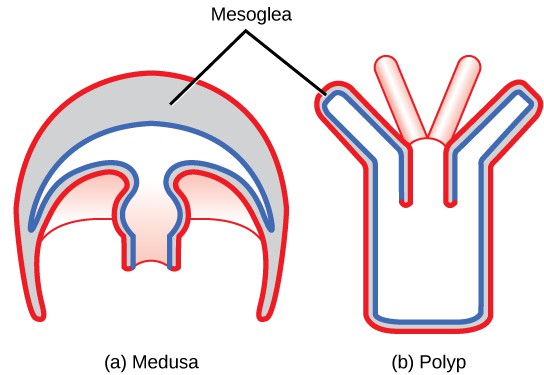
Cnidarians brandish two singled-out body plans: polyp or "stalk" and medusa or "bell" ([Figure 4]). Examples of the polyp form are freshwater species of the genus Hydra; maybe the best-known medusoid animals are the jellies (jellyfish). Polyps are sessile every bit adults, with a single opening to the digestive system (the mouth) facing upwardly with tentacles surrounding it. Medusae are motile, with the mouth and tentacles hanging from the bell-shaped body. In other cnidarians, both a polyp and medusa course be, and the life cycle alternates betwixt these forms.
Physiological Processes of Cnidarians
All cnidarians have two tissue layers. The outer layer is called the epidermis, whereas the inner layer is called the gastrodermis and lines the digestive crenel. Between these two layers is a not-living, jelly-similar mesoglea. There are differentiated cell types in each tissue layer, such as nerve cells, enzyme-secreting cells, and nutrient-arresting cells, as well as intercellular connections between the cells. Nevertheless, organs and organ systems are not present in this phylum.
The nervous system is primitive, with nerve cells scattered across the torso in a network. The function of the nerve cells is to conduct signals from sensory cells and to contractile cells. Groups of cells in the nerve internet grade nervus cords that may exist essential for more rapid transmission. Cnidarians perform extracellular digestion, with digestion completed past intracellular digestive processes. Food is taken into the gastrovascular cavity, enzymes are secreted into the cavity, and the cells lining the cavity absorb the nutrient products of the extracellular digestive process. The gastrovascular cavity has only one opening that serves every bit both a oral cavity and an anus (an incomplete digestive organization). Like the sponges, Cnidarian cells exchange oxygen, carbon dioxide, and nitrogenous wastes by improvidence between cells in the epidermis and gastrodermis with h2o.
Cnidarian Diverseness
The phylum Cnidaria contains about 10,000 described species divided into 4 classes: Anthozoa, Scyphozoa, Cubozoa, and Hydrozoa.
The class Anthozoa includes all cnidarians that showroom a sessile polyp body plan only; in other words, there is no medusa phase within their life bike. Examples include sea anemones, bounding main pens, and corals, with an estimated number of half dozen,100 described species. Bounding main anemones are usually brightly colored and can attain a size of 1.8 to 10 cm in bore. These animals are usually cylindrical in shape and are fastened to a substrate. A mouth opening is surrounded past tentacles bearing cnidocytes ([Figure 5]).

Scyphozoans include all the jellies and are motile and exclusively marine with about 200 described species. The medusa is the dominant stage in the life cycle, although there is also a polyp phase. Species range from 2 cm in length to the largest scyphozoan species, Cyanea capillata, at 2 m across. Jellies brandish a feature bong-like body shape ([Figure six]).

Place the life bicycle stages of jellies using this video animation game from the New England Aquarium.
The class Cubozoa includes jellies that are foursquare in cross-section and so are known equally "box jellyfish." These species may achieve sizes of 15–25 cm. Cubozoans are anatomically similar to the jellyfish. A prominent difference between the two classes is the arrangement of tentacles. Cubozoans have muscular pads called pedalia at the corners of the square bell canopy, with one or more tentacles attached to each pedalium. In some cases, the digestive system may extend into the pedalia. Cubozoans typically exist in a polyp course that develops from a larva. The polyps may bud to form more polyps and then transform into the medusoid forms.
Watch this video to acquire more about the mortiferous toxins of the box jellyfish.
Hydrozoa includes almost iii,500 species, 1 near of which are marine. Near species in this class have both polyp and medusa forms in their life cycle. Many hydrozoans class colonies composed of branches of specialized polyps that share a gastrovascular cavity. Colonies may besides be gratuitous-floating and comprise both medusa and polyp individuals in the colony, every bit in the Portuguese Man O'State of war (Physalia) or Past-the-Wind Sailor (Velella). Other species are solitary polyps or solitary medusae. The characteristic shared by all of these species is that their gonads are derived from epidermal tissue, whereas in all other cnidarians, they are derived from gastrodermal tissue ([Figure 7]ab).

Section Summary
Animals included in phylum Porifera are parazoans and do not possess true tissues. These organisms show a uncomplicated organization. Sponges have multiple prison cell types that are geared toward executing various metabolic functions.
Cnidarians have outer and inner tissue layers sandwiching a noncellular mesoglea. Cnidarians possess a well-formed digestive arrangement and carry out extracellular digestion. The cnidocyte is a specialized cell for delivering toxins to prey and predators. Cnidarians accept dissever sexes. They take a life wheel that involves morphologically singled-out forms—medusoid and polypoid—at diverse stages in their life bike.
Review Questions
The large central opening in the poriferan body is called the _____.
- emmule
- picule
- stia
- osculum
[reveal-answer q="514015″]Show Answer[/reveal-answer]
[subconscious-answer a="514015″]4[/hidden-answer]
Cnidocytes are found in _____.
- phylum Porifera
- phylum Nemertea
- phylum Nematoda
- phylum Cnidaria
[reveal-answer q="878659″]Bear witness Answer[/reveal-answer]
[hidden-answer a="878659″]4[/subconscious-answer]
Cubozoans are ________.
- polyps
- medusoids
- polymorphs
- sponges
[reveal-respond q="908474″]Evidence Answer[/reveal-answer]
[hidden-answer a="908474″]2[/hidden-respond]
Free Response
Describe the feeding mechanism of sponges and identify how it is different from other animals.
The sponges draw water carrying nutrient particles into the spongocoel using the beating of flagella in the choanocytes. The nutrient particles are caught by the neckband of the choanocyte and brought into the cell by phagocytosis. Digestion of the food particle takes place inside the cell. The difference between this and the mechanisms of other animals is that digestion takes place inside cells rather than outside of cells. It means that the organism can feed only on particles smaller than the cells themselves.
Compare the structural differences between Porifera and Cnidaria.
Poriferans practice not possess truthful tissues, whereas cnidarians do have tissues. Considering of this difference, poriferans exercise not have a nervus net or muscle cells for locomotion, which cnidarians accept.
Footnotes
- i "The Hydrozoa Directory," Peter Schuchert, Muséum Genève, terminal updated Nov 2012, http://www.ville-ge.ch/mhng/hydrozoa/hydrozoa-directory.htm.
Glossary
- amoebocyte
- an amoeba-like cell of sponges whose functions include distribution of nutrients to other cells in the sponge
- budding
- a form of asexual reproduction that occurs through the growth of a new organism as a branch on an adult organism that breaks off and becomes independent; found in plants, sponges, cnidarians, and another invertebrates
- choanocyte
- a cell blazon unique to sponges with a flagellum surrounded by a neckband used to maintain h2o flow through the sponge, and capture and digest food particles
- Cnidaria
- a phylum of animals that are diploblastic and have radial symmetry and stinging cells
- cnidocyte
- a specialized stinging jail cell found in Cnidaria
- epidermis
- the layer of cells that lines the outer surface of an animal
- extracellular digestion
- a form of digestion, the breakdown of food, which occurs outside of cells with the aid of enzymes released by cells
- fragmentation
- a form of asexual reproduction in which a portion of the torso of an organism breaks off and develops into a living independent organism; found in plants, sponges, and another invertebrates
- gastrodermis
- the layer of cells that lines the gastrovascular crenel of cnidarians
- gastrovascular cavity
- the central cavity divisional by the gastrodermis in cnidarians
- gemmule
- a construction produced by asexual reproduction in freshwater sponges that is able to survive harsh conditions
- intracellular digestion
- the digestion of matter brought into a cell by phagocytosis
- medusa
- a free-floating cnidarian torso programme with a oral cavity on the underside and tentacles hanging down from a bong
- mesoglea
- the non-living, gel-like matrix nowadays in between ectoderm and endoderm in cnidarians
- mesohyl
- the collagen-like gel containing suspended cells that perform various functions in sponges
- monoecious
- having both sexes in one trunk, hermaphroditic
- nematocyst
- the harpoon-like organelle within a cnidocyte with a pointed projectile and poison to stun and entangle prey
- osculum
- the big opening in a sponge torso through which water leaves
- polyp
- the stalk-like, sessile life course of a cnidarians with mouth and tentacles facing upward, commonly sessile simply may be able to glide along a surface
- Porifera
- a phylum of animals with no truthful tissues, but a porous body with a rudimentary endoskeleton
- spicule
- a short sliver or fasten-like construction, in sponges, they are formed of silicon dioxide, calcium carbonate, or protein, and are found in the mesohyl
- spongocoel
- the key cavity within the body of some sponges
Source: https://opentextbc.ca/conceptsofbiologyopenstax/chapter/sponges-and-cnidarians/
Posted by: spraguethicamewyn.blogspot.com
0 Response to "How Do Sponges Differ From All Other Animals"
Post a Comment