

What Was Theodoras Favorite Animal At The Circus
The about powerful adult female in Byzantine history was the girl of a bear trainer for the circus. Theodora (ca. 497-548) grew upwards in what her contemporaries regarded as an undignified and morally suspect atmosphere, and she worked as a dancer and burlesque actress, both dishonorable occupations in the Roman globe. Despite her groundwork, she caught the eye of Justinian, who was then a armed services leader and whose uncle (and adoptive father) Justin had himself risen from obscurity to become the emperor of the Byzantine Empire. Under Justinian'due south influence, Justin changed the law to allow an actress who had left her disreputable life to ally whom she liked, and Justinian and Theodora married in 525. When Justinian was proclaimed coemperor with his uncle Justin on Apr one, 527, Theodora received the rare title of augusta, empress. Thereafter her proper noun was linked with Justinian'due south in the exercise of purple power.
Most of our cognition of Theodora's early life comes from the Secret History, a tell-all clarification of the vices of Justinian and his court, written by Procopius (proh-KOH-pee-uhs) (ca. 550), who was the official courtroom historian and thus spent his days praising those same people. In the Secret History, he portrays Theodora and Justinian every bit demonic, greedy, and cruel, killing courtiers to steal their property. In scene after detailed scene, Procopius portrays Theodora as specially evil, sexually clamorous, depraved, and fell, a temptress who used sorcery to attract men, including the hapless Justinian.
In one of his official histories, The History of the Wars of Justinian, Procopius presents a very different Theodora. Riots between the supporters of two teams in chariot races — who formed associations somewhat like street gangs and somewhat like political parties — had turned deadly, and Justinian wavered in his treatment of the perpetrators. Both sides turned against the emperor, besieging the palace while Justinian was inside information technology. Shouting N-I-K-A (victory), the rioters swept through the city, burning and looting, and destroyed one-half of Constantinople. Justinian's counselors urged flight, just, according to Procopius, Theodora rose and declared:
For i who has reigned, it is intolerable to be an exile. . . . If y'all wish, O Emperor, to relieve yourself, there is no difficulty: nosotros have ample funds and there are the ships. Yet reflect whether, when y'all have in one case escaped to a identify of security, you volition not adopt death to safe. I agree with an old maxim that the purple [that is, the color worn merely by emperors] is a fair winding canvas to be buried in.
Justinian rallied, had the rioters driven into the hippodrome, and ordered between thirty and thirty-five 1000 men and women executed. The revolt was crushed and Justinian'due south authorisation restored, an outcome approved by Procopius.
Other sources describe or advise Theodora's influence on purple policy. Justinian passed a number of laws that improved the legal status of women, such as allowing women to own property the same fashion that men could and to exist guardians over their own children. He forbade the abandonment of unwanted infants, which happened more than often to girls than to boys, as boys were valued more highly. Theodora presided at impe rial receptions for Arab sheiks, Persian ambassadors, Germanic princesses from the West, and barbarian chieftains from southern Russia. When Justinian fell ill from the bubonic plague in 532, Theodora took over his duties, banning those who discussed his possible successor. Justinian is reputed to take consulted her every 24-hour interval nearly all aspects of state policy, including religious policy regarding the doctrinal disputes that continued throughout his reign. Theodora's favored interpretation of Christian doctrine nigh the nature of Christ was not accepted past the master trunk of theologians in Constantinople—nor by Justinian — but she urged protection of her boyfriend believers and in one case hid an aged scholar in the women's quarters of the palace for many years.
Theodora's influence over her married man and her power in the Byzantine land continued until she died, perchance of cancer, xx years before Justinian. Her
Influence may accept even continued after death, for Justinian continued to pass reforms favoring women and, at the end of his life, accepted her estimation of Christian doctrine. Institutions that she established, including hospitals, orphanages, houses for the rehabilitation of prostitutes, and churches, connected to be reminders of her charity and piety.
Theodora has been viewed every bit a symbol of the manipulation of beauty and cleverness to accomplish position and power, and as well as a strong and capable co-ruler who held the empire together during riots, revolts, and mortiferous epidemics. Just as Procopius expressed both
Views, the debate continues today among writers of science fiction and fantasy as well as biographers and historians.
Questions for Assay
1. How would you assess the complex legacy of Theodora?
two. Since the public and private views of Procopius are so different regarding the empress, should he exist trusted at all as a historical source?
Much equally we use the terms the college or the university when referring to academic administrators.
In early Christian communities the local people elected their leaders, or bishops. Bishops were responsible for the community's goods and oversaw the distribution of those appurtenances to the poor. They also were responsible for maintaining orthodox (established or right) doctrine within the customs and for preaching. Bishops solitary could confirm believers in their organized religion and ordain men as priests.
The early Christian church benefited from the brilliant administrative abilities of some bishops. Bishop Ambrose, for example, the son of the Roman prefect of Gaul, was a trained lawyer and the governor of a province. He is typical of the Roman aristocrats who held high public office, were converted to Christianity, and afterwards became bishops. Such men later provided social continuity from Roman to Germanic rule. As bishop of Milan, Ambrose himself exercised responsibility in both the business and church diplomacy of northern Italy.
During the reign of Diocletian (284-305), the Roman Empire had been divided for administrative purposes into geographical units called dioceses. Gradually the church made apply of this organizational structure. Christian bishops established their headquarters, or sees, in the urban centers of the old Roman dioceses. A bishop's jurisdiction extended throughout the diocese. The middle of his authority was his cathedral (from the Latin cathedra, meaning "chair"). Thus, church leaders adjusted the Roman regal method of organization for ecclesiastical purposes.
The bishops of Rome-known as "popes," from the Latin word papa, pregnant "father"—claimed to speak and act equally the source of unity for all Christians. They based their merits to be the successors of Saint Peter and heirs to his authorisation every bit chief of the apostles on Jesus' words:
You are Peter, and on this stone I will build my church, and the jaws of expiry shall not prevail against it. I will entrust to you lot the keys of the kingdom of heaven. Whatever you lot declare bound on globe shall be bound in heaven; whatever you declare loosed on earth shall exist loosed in heaven.1
Petrine Doctrine The statement used past popes, bishops of Rome, based on Jesus' words, to substantiate their claim
Of existence the successors of Saint Peter and heirs to his potency every bit primary of the apostles.
Theologians phone call this argument the Petrine (PEE-tryne) Doctrine.
After the capital and the emperor moved from Rome to Constantinople (see page 128), the bishop of Rome exercised considerable influence in the Westward considering he had no real competitor in that location. He became known as the "Patriarch of the West." In the East, the bishops of Antioch, Alexandria, Jerusalem, and Constantinople, because of the special dignity of their sees, as well gained the championship of patriarch. Their jurisdictions extended over lands adjoining their sees; they consecrated bishops, investigated heresy, and heard judicial appeals.
In the fifth century the bishops of Rome began to stress their supremacy over other Christian communities and to urge other churches to appeal to Rome for the resolution of disputed doctrinal problems. While local churches oft exercised their own say-so and Rome was non still as powerful equally it would become, these arguments laid the groundwork for later appeals.
The Church and the Roman Emperors
The church benefited considerably from the emperors' support. Constantine had legalized the practise of Chris t ianity in the empire in 312 and encouraged information technology throughout his reign. He freed the clergy from imperial revenue enhancement. At churchmen's request, he helped settle theological disputes and thus preserved doctrinal unity inside the church. Constantine generously endowed the building of Christ ian
Churches, and one of his gifts —the Lateran (LAT-er-uhn) Palace in Rome-remained the official residence of the popes until the fourteenth century. Constantine also alleged Sun a public holiday, a solar day of balance for the service of God. Because of its favored position in the empire, Christianity slowly became the leading religion (run into Map vii.ii).
Arianism A theological belief that originated with Arius, a priest of Alexandria, denying that Christ was divine and co-eternal with God the Father.
I heresy The denial of a basic doctrine I of faith.
In the fourth century, theological disputes oftentimes and sharply divided the Christian customs. Some disagreements had to do with the nature of Christ. For example, Arianism (AIR-ree-uh-nizm), which originated with Arius (ca. 250336), a priest of Alexandria, held that Jesus was created by the will of the Begetter and thus was non co-eternal with the Father. Arius also reasoned that Jesus the Son must be junior to God the Father considering the Father was incapable of suffering and did not dice. Orthodox theologians branded Arius's position a heresy—the denial of a basic doctrine of organized religion.
Arianism enjoyed such popularity and provoked such controversy that Constantine, to whom religious disagreement meant civil disorder, interceded. He summoned church building leaders to a quango in Nicaea (neye-Run into-uh) in Asia Modest and presided over information technology personally. The council produced the Nicene (neye-SEEN) Creed, which defined the orthodox position that Christ is "eternally begotten of
MAP 7.two The Spread of Christianity
Originating in Judaea, the southern part of modern Israel and Jordan, Christianity first spread throughout the Roman globe and then across it in all directions.

The Father" and of the same substance as the Father. Arius and those who refused to accept the creed were banished, the first instance of civil punishment for heresy. This participation of the emperor in a theological dispute inside the church paved the way for afterwards emperors to do the aforementioned.
In 380 the emperor Theodosius fabricated Christianity the official organized religion of the empire. Theodosius stripped Roman pagan temples of statues, made the exercise of the onetime Roman state organized religion a treasonable offense, and persecuted Christians who dissented from orthodox doctrine. Most significant, he allowed the church building to constitute its own courts and to utilize its own trunk of law, called "canon law." These courts, not the Roman regime, had jurisdiction over the clergy and ecclesiastical disputes. At the expiry of Theodosius, the Christian church was considerably independent of the Roman state. The foundation for subsequently growth in church power had been laid.
Orthodox church Eastern orthodox church building in the Byzantine empire.
Later Byzantine emperors continued the pattern of active involvement in church building affairs. They appointed the highest officials of the church building hierarchy and presided over ecumenical councils, where bishops would gather to brand decisions on matters of faith and practise. The emperors also controlled some of the material resource of the church building-land, rents, and indebted peasants. On the other hand, the emperors had minimal involvement in church services and rarely tried to impose their views in theological disputes. Greek churchmen vigorously defended the church'southward independence; some even asserted the superiority of the bishop's potency over the emperor'due south; and the church possessed such enormous economic wealth and influence over the population that it could block government decisions. The Orthodox church, the name mostly given to the Eastern Christian church, was less independent of secular control than the Western Christian church building, merely information technology was not simply a branch of the Byzantine state.
The Development of Christian Monasticism
Christianity began and spread as a metropolis religion. Since the first century, withal, some especially pious Christians had felt that the merely alternative to the decadence of urban life was complete separation from the world. All-consuming pursuit of textile things, sexual promiscuity, and general political corruption disgusted them. They believed that the Christian life as fix forth in the Gospel could not exist lived in the midst of such immorality. They rejected the values of Roman society and were the outset real nonconformists in the church building.
Eremitical A form of monasticism that began in Egypt in the third century where individuals and small groups withdrew from cities and organized society to seek God through prayer. The people who lived in caves and sought shelter in the desert and mountains were called hermits, from the Greek word eremos.
This desire to withdraw from ordinary life led to the evolution of the monastic life. Some scholars believe that the monastic life of extreme textile sacrifice appealed to Christ ians who wanted to make a total response to Christ's teachings; the monks became the new martyrs. Saint Anthony of Egypt (251?-356), the earliest monk for whom there is concrete evidence and the man afterwards considered the father of monasticism, went to Alexandria during the persecutions of the Emperor Diocletian in the promise of gaining martyrdom. Christians believed that monks similar the martyrs before them, could speak to God and that their prayers had special influence.
Monasticism began in Egypt in the third century. At first individuals and small groups withdrew from cities and from organized social club to seek God through prayer in desert or mountain caves and shelters. Gradually large colonies of monks gathered in the deserts of Upper Egypt. These monks were called hermits, from the Greek word eremos, meaning "desert." Many devout women also were attracted to this eremitical (er-uh-MIT-ik-ul) blazon of monasticism.
The Egyptian ascetic Pachomius (puh-KOH-mee-uhs) (290-346?) drew thousands of men and women to the monastic life at Tabennisi on the Upper Nile. There were as well many for them to live as hermits, and Pachomius organized communities of men and women, creating a second blazon of monasticism, known as coenobitic (seh-nuh-Flake-ik) (communal). Saint Basil (329?-379), the scholarly bishop from Asia Minor, encouraged coenobitic monasticism, as he and the church hierarchy thought that communal living provided an environment for preparation the aspirant in the virtues of charity, poverty, and freedom from cocky-charade.
Western and Eastern Monasticism
Coenobitic monasticism Communal
Living in monasteries, encouraged by Saint Basil and the church building because information technology provided an environment for preparation the aspirant in the virtues of charity, poverty, and liberty from self-charade.
In the fourth, fifth, and sixth centuries, information well-nigh Egyp tian monasticism came to the West, and both men and women sought the monastic life. Because of the difficulties and dangers of living alone in the forests of northern Europe, the eremitical class of monasticism did non take root. Nigh of the monasticism that developed in Gaul, Italia, Espana, England, and Republic of ireland was coenobitic.
Regular clergy Men and women who lived in monastic houses and followed sets of rules, commencement those of Benedict and afterward those written by other individuals.
Secular clergy Priests and bishops who staffed churches where people worshiped and were not cut off from the world.
In 529 Benedict of Nursia (480-543), who had experimented with both the eremitical and the communal forms of monastic life, wrote a cursory set of regulations for the monks who had gathered effectually him at Monte Cassino between Rome and Naples. Benedict'south guide for monastic life, known as the Dominion of Saint Benedict, slowly replaced all others. The Rule of Saint Benedict came to influence all forms of organized religious life in the Roman church. Men and women who lived in monastic houses all followed sets of rules, commencement those of Benedict and afterwards those written past other individuals, and considering of this came to exist called regular clergy, from the Latin discussion regulus (rule). Priests and bishops who staffed churches in which people worshiped and who were not cut off from the world were called secular clergy. (According to official church building doctrine, women are not members of the clergy, but this distinction was not articulate to most medieval people.)
The Rule of Saint Benedict offered a uncomplicated code for ordinary men. It outlined a monastic life of regularity, discipline, and moderation in an atmosphere of silence. Each monk had ample food and adequate slumber. The monk spent part of each day in formal prayer, which Benedict called the Opus Dei (Piece of work of God) and Christians afterwards termed the divine office, the public prayer of the church building. This consisted of chanting psalms and other prayers from the Bible in the part of the monastery church called the "choir." The rest of the 24-hour interval was passed in manual labor, report, and individual prayer.
Why did the Benedictine course of monasticism somewhen replace other forms of Western monasticism? The monastic life as conceived past Saint Bridegroom struck a balance between asceticism and activity. Information technology thus provided opportunities for men of entirely different abilities and talents—from mechanics to gardeners to literary scholars. The Benedictine form of religious life as well proved congenial to women. Five miles from Monte Cassino at Plombariola, Bridegroom's twin sis Scholastica (skoh-LAS-tih-kuh) (480-543) adapted the Rule for utilise by her community of nuns.
Benedictine monasticism also succeeded partly considering it was so materially successful. In the seventh and eighth centuries monasteries pushed back forests and wastelands, drained swamps, and experimented with ingather rotation. Benedictine houses fabricated a pregnant contribution to the agricultural development of Europe. The communal nature of their organization, whereby belongings was held in mutual and profits were pooled and reinvested, made this contribution possible.
Finally, monasteries conducted schools for local immature people. Some students learned about prescriptions and herbal remedies and went on to provide medical
Department Review
Early Christian communities elected their leaders, or bishops, who oversaw the doctrine, preaching, and other community functions of their jurisdiction (diocese).
The bishops of Rome, known as "popes," exercised more and more than ability, claiming to speak and act as the unitary source of authority for all Christians, while enjoying the benefits of the emperor's support.
Constantine prepare upwards and presided over the council of Nicaea, producing the Nicene Creed, which declared Jesus to be divine and settled a dispute betwixt 2 Christian factions past banishing anyone who refused to accept information technology.
Those who wanted to separate themselves from perceived corruption in society chose one of the two monastic lifestyles: eremitical (isolated) or coenobitic (communal).
The monk Benedict of Nursia wrote a gear up of regulations for monks that became favored for both monks (men) and nuns (women) because of its balance betwixt divineness and activity.
Monasteries were successful in both the East and Westward simply but the Western monasteries provided schools with educational grooming for local immature people.
Treatment in their localities. A few copied manuscripts and wrote books. Local and royal governments drew on the services of the literate men and able administrators the monasteries produced. This was non what Saint Bridegroom had intended, but perhaps the effectiveness of the establishment he designed made it inevitable.
Monasticism in the Greek Orthodox earth differed in key ways from the monasticism that evolved in western Europe. First, while The Dominion of Saint Bridegroom gradually became the universal guide for all western European monasteries, each individual house in the Byzantine world adult its ain fix of rules for organizat ion and behavior, including rules well-nigh nutrition, wear, liturgical functions, commemorative services for benefactors, the training of monks and nuns, and the election of officials. Second, educational activity never became a primal characteristic of the Greek houses. Monks and nuns had to exist literate to perform the services of the choir, merely no monastery assumed responsibility for the general training of the local immature.
There were also similarities between Western and Eastern monasticism. As in the W, Eastern monasteries became wealthy, with fields, pastures, livestock, and buildings. Since bishops and patriarchs of the Greek church building were recruited merely from the monasteries, Greek houses besides exercised cultural influence.
Christian Ideas and Practices
How did Christian thinkers accommodate Greco-Roman ideas to Christian theology?
The development of Christianity was not simply a matter of institutions such every bit the papacy and monasteries, but besides of ideas. Initially, Christians had believed that the cease of the world was near and that they should dissociate themselves from the "filth" of Roman culture. The church male parent Tertullian (ter-TUHL-ee-uhn) (ca. 160-220) claimed: "We have no demand for curiosity since Jesus Christ, nor for inquiry since the gospel." Gradually, however, Chris tians adult a culture of ideas that drew upon classical influences. The distinguished theologian Saint Jerome (340-419) translated the Old and New Testaments from Hebrew and Greek into vernacular Latin; his edition is known as the "Vulgate." The synthesis of Greco-Roman and Christ ian ideas found greatest expression in the writings of Saint Augustine, whose work had a profound influence on Christian theology.
Chris tian attitudes toward gender and sexuality pro
Christian Notions of , , i i mr, r k grand
Vide a good example of the ways early Christians both
Gender and Sexuality a, a due north due north r n rk crk
Adopted and adapted the views of their contemporary world. In his programme of conservancy, Jesus considered women the equal of men. He attributed no disreputable qualities to women and did not refer to them as inferior creatures. On the contrary, women were among his earliest and about true-blue converts. He discussed his mission with them (John 4:21-25), and the first persons to whom he revealed himself later on his resurrection were women (Matthew 28:nine-10).
Women took an active office in the spread of Christianity, preaching, acting as missionaries, being martyred alongside men, and perhaps even baptizing believers. Because early Christians believed that the Second Coming of Christ was imminent, they devoted their energies to their new spiritual family of co-believers. Early on Christians oftentimes met in people'southward homes and called one another brother and sister, a metaphorical use of family terms that was new to the Roman Empire.

Saint Augustine on Man Nature, Will, and Sin
The Marys at Jesus' Tomb
This late-4th-century ivory panel tells the story of Mary Magdalene and some other Mary who went to Jesus' tomb to bless the body (Matthew 28:ane-seven). At the height, guards plummet when an affections descends from Heaven, and at the lesser, the Marys heed to the angel telling them that Jesus had risen. Immediately subsequently this, co-ordinate to Matthew'due south Gospel, Jesus appears to the women. Hither the artist uses Roman artistic styles to convey Christian subject matter, an example of the assimilation of classical grade and Christian teaching. (Castello Sforzesco/Scala/Art Resources, NY)
Some women embraced the ideal of virginity and either singly or in monastic communities declared themselves "virgins in the service of Christ." All this made Christianity seem dangerous to many Romans, especially when becoming Chris tian actually led some immature people to avert marriage, which was viewed by Romans as the foundation of society and the proper patriarchal society.
Non all Christian teachings almost gender were radical, however. In the showtime century c. due east. male church leaders began to identify restrictions on female person believers. Paul and later writers forbade women to preach, and women were gradually excluded from holding official positions in Christianity other than in women'south monasteries. In and then limiting the activities of female believers Christianity was following classical Mediterranean culture, just equally information technology patterned its official hierarchy after that of the Roman Empire.
Christian teachings about sexuality as well congenital on classical civilisation. Many early church leaders, who are frequently called the church fathers, renounced wedlock and sought to live celibate lives not merely considering they expected the Second Coming imminently, but also considering they accustomed the hostility toward the body that derived from sure strains of Hellenistic philosophy. Merely as spirit was superior to matter, the mind was superior to the torso. Though God had clearly sanctioned union, celibacy was the highest skillful. This accent on self-denial led to a strong streak of misogyny (hatred of women) in their writings, for they saw women and female sexuality equally the primary obstacles to their preferred existence. They also saw intercourse every bit little more than fauna lust, the triumph of the inferior trunk over the superior heed. Aforementioned-sexual activity relations — which were generally adequate in the Greco-Roman world, particularly if they were between socially unequal individuals—were evil. The church fathers' misogyny and hostility toward sexuality had a greater influence on the formation of later attitudes than did the relatively egalitarian actions and words of Jesus.
The virtually influential church father in the Due west was Saint Augustine of Hippo (354-430). Saint Augustine was built-in into an urban family in what is at present Algeria in Northward Africa. His father, a modest civil servant, was a pagan; his mother, Monica, a devout Christian. It was not until adulthood that he converted to his mother'south religion. As bishop of the city of Hippo Regius, he was a renowned preacher, a vigorous defender of orthodox Christ ianity, and the author of more than xc-three books and treatises.
Augustine'southward autobiography, The Confessions, is a literary masterpiece. Written in the rhetorical mode and language of late Roman antiquity, information technology marks the synthesis of Greco-Roman forms and Christian idea. The Confessions describes Augustine's moral struggle, the disharmonize betwixt his spiritual aspirations and his sensual cocky. Many Greek and Roman philosophers had taught that knowledge and virtue are the aforementioned: a person who knows what is right will do what is right. Augustine rejected this idea. People practise non ever human action on the basis of rational knowledge.
Sacraments Sure rituals defined by the church in which God bestows benefits on the believer through grace.
Department Review
Christians at beginning thought the end of the globe was near then they should separate themselves from Roman culture, but gradually they adult a culture of ideas that included classical influences.
Initially, both men and women played of import roles, with women preaching and acting as missionaries, but in the first century C. E. male leaders, following classical culture, began to restrict women's participation in official positions.
Christian teachings on sexuality also adopted ideas from certain strains of Hellenistic philosophy, prescribing celibacy and self-denial equally the highest good, leading to misogyny and hostility toward women and same-sex relations.
Augustine'due south ideas about sin (the issue of will) and grace (the result of God, not humans) became the foundation for Western Christian theology.
Augustine argued in his work City of God that the state is the result of people's will to sin and that the church is responsible for the conservancy of all, leading to the church's political view that it was superior to secular potency.
I
For example, Augustine regarded a life of chastity equally the best possible life fifty-fifty earlier he became a Christian. As he notes in The Confessions, as a young human being he prayed to God for "guiltlessness and continency" and added "simply not yet." His education had not fabricated his will strong plenty to avoid temptation; that would come but through God'southward ability and grace.
Augustine's ideas on sin, grace, and redemption became the foundation of all subsequent Western Christian theology, Protestant as well as Cosmic. He wrote that the bones or dynamic force in any private is the will. When Adam ate the fruit forbidden by God in the Garden of Eden (Genesis 3:half-dozen), he committed the "original sin" and corrupted the volition. Adam'due south sin was non simply his own, merely was passed on to all subsequently humans through sexual intercourse; fifty-fifty infants were tainted. Augustine viewed sexual desire equally the result of Adam and Eve's disobedience, linking sexuality even more clearly with sin than had earlier church fathers. Because Adam disobeyed God, all man beings take an innate trend to sin: their volition is weak. But according to Augustine, God restores the strength of the will through grace, which is transmitted in certain rituals that the church building defined as sacraments. Grace results from God's decisions, not from whatsoever merit on the part of the individual.
When the Visigothic (viz-ee-GOTH-ic) chieftain Alaric (AL-er-ik) conquered Rome in 410, horrified pagans blamed the disaster on the Christians. In response, Augustine wrote City of God. This original work contrasts Christianity with the secular society in which it existed. Co-ordinate to Augustine, history is the account of God acting in time. Human history reveals that there are two kinds of people: those who live the life of the mankind in the Metropolis of Babylon and those who live the life of the spirit in the Metropolis of God. The one-time will endure eternal hellfire; the latter will savour eternal bliss.
Augustine maintained that states came into existence as the result of people's inclination to sin. The country provides the peace, justice, and order that Christians demand in order to pursue their pilgrimage to the City of God. The church, while not the equivalent of the City of God, is responsible for the salvation of all-including Christian rulers. Churches afterwards used Augustine'south theory to argue their superiority over secular authority. This remained the ascendant political theory until the tardily thirteenth century.
Christian Missionaries and Conversion
What techniques did missionaries develop to convert barbaric peoples to Christianity?
The discussion catholic derives from a Greek give-and-take significant "general," "universal," or "worldwide." Christ had said that his teaching was for all peoples, and Christians sought to make their faith catholic-that is, believed everywhere. This could be accomplished only through missionary activity. Equally Saint Paul had written to the Christian community at Colossae (kuh-LOS-ee) in Asia Modest, "there is no room for distinction between Greek and Jew, between the circumcised or the uncircumcised, or between barbarian or Scythian (SITH-ee-uhn), slave and free human. In that location is only Christ; he is everything and he is in everything."2 Paul urged Christians to bring the "expert news" of Christ to all peoples. The Mediterranean served as the highway over which Christianity spread to the cities of the Roman Empire. From at that place missionaries took Christian teachings to the countryside, and so to areas beyond the borders of the empire.
Among the Germanic tribes of western Europe, religion was not a private or individual matter. It was a social thing, and the religion of the chieftain or rex determined the faith of the people. Thus missionaries full-bodied their initial efforts not on the people, but on kings or tribal chieftains. According to custom, kings negotiated with all foreign powers, including the gods. Considering Chris tian missionaries represented a "foreign" ability (the Chris tian God), the king dealt with them. Germanic kings accepted Christianity because they believed that the Christian God was more powerful than infidel gods and that the Christian God would deliver victory in battle, or because Christianity taught obedience to (kingly) authority, or because Christian priests possessed knowledge and a charisma that could be associated with kingly power. Kings who converted, such as Ethelbert of Kent and the Frankish chieftain Clovis (KLOH-vis), sometimes had Chris tian wives. Conversion may also have indicated that barbarian kings wanted to enjoy the cultural advantages that Christianity brought, such as literate assistants and an ideological basis for their dominion.
Missionaries on the Continent
In eastern Europe, missionaries traveled far beyond the boundaries of the Byzantine Empire. In 863 the emperor Michael III sent the brothers Cyril (826-869) and Methodius (815-885) (muh-THOH-dee-uhs) to preach Christianity in Moravia (a region of the modern central Czech Republic). Other missionaries succeeded in converting the Russians in the tenth century. Cyril invented a Slavic alphabet using Greek characters; this script, called the "Cyrillic (sih-RIL-ik) alphabet," is yet in use today. Cyrillic script made possible the birth of Russian literature. Similarly, Byzantine art and architecture became the basis and inspiration of Russian forms. The Byzantines were and then successful that the Russians claimed to be the successors of the Byzantine Empire. For a time Moscow was fifty-fifty known equally the "Third Rome" (the second Rome being Constantinople).
Missionaries in The British Isles
Ardagh Silverish Chalice
This chalice, crafted about 800 c. east. and used for wine in Christian ceremonies, formed function of the treasure of Ardagh Cathedral in County Composition, Ireland. Made of several types of metallic, it is busy with Celtic patterns in the same fashion equally Irish gaelic manuscripts from this era. Christianity was widespread in Ireland long earlier anywhere else in northern Europe, and Celtic traditions and practices differed significantly from those of Rome. (National Museum of Ireland)
Tradition identifies the conversion of the Celts of Republic of ireland with Saint Patrick (ca. 385-461). After a vision urged him to Christianize Ireland, Patrick studied in Gaul and was consecrated a bishop in 432. He returned to Ireland, where he converted the Irish tribe by tribe, start baptizing the rex. By the time of Patrick's death, the majority of the Irish people had received Christian baptism. In his missionary work, Patrick had the strong support of Bridget of Kildare (kil-DAIR) (ca. 450-ca. 528), girl of a wealthy chieftain. Bridget defied parental force per unit area to marry and became a nun. She and the other nuns at Kildare instructed relatives and friends in bones Christian doctrine, made religious vestments for churches, copied books, taught children, and higher up all ready a religious instance by their lives of prayer. In Ireland and later in continental Europe, women shared in the process of conversion.
The Christianization of the Engl ish began in 597, when Pope Gregory I (590-604) sent a delegation of monks nether the Roman Augustine to Britain. Augustine's approach, similar Patrick's, was to concentrate on converting the king. When he succeeded in converting Ethelbert, king of Kent, the baptism of Ethelbert's people took place equally a matter of class. Augustine established his headquarters, or see, at Canterbury, the capital of Kent.
In the form of the seventh century, ii Christian forces competed for the conversion of the pagan Anglo-Saxons: Roman-oriented missionaries traveling due north from Canterbury, and Celtic monks from Ireland and northwestern Britain. The Roman and Celtic church building organization, types of monastic life, and methods of arriving at the engagement of the central feast of the Christian agenda (Easter) differed completely. Through the influence of Male monarch Oswiu of Northumbria (nawr-THUHM-bree-uh) and the energetic abbess Hilda of Whitby, the Synod (ecclesiastical council) held at Whitby in 664 opted to follow the Roman practices. The conversion of the English and the shut attachment of the English church building to Rome had far-reaching consequences because Britain later served as a base for the total-calibration Christianization of the continent (encounter Map seven.ii).
Conversion and Assimilation
Between the fifth and tenth centuries, the corking majority of peoples living on the European continent and the nearby islands were baptized every bit Christians. When a ruler marched his people to the waters of baptism, though, the work of Christianization had only begun. Baptism meant either sprinkling the caput or immersing the trunk in h2o. Conversion meant awareness and acceptance of the behavior of Christianity, including those that seemed strange or radical, such as "dearest your enemies" or "do good to those that hate you."
How did missionaries and priests get masses of heathen and illiterate peoples to empathise and live by Christian ideals and teachings? They did then through preaching, assimilation, and the penitential system. Preaching aimed at presenting the basic teachings of Christ ianity and strengthening the newly baptized in their organized religion through stories most the lives of Christ and the saints. Only deeply ingrained infidel customs and practices could not exist stamped out by words solitary or even by royal edicts. Christian missionaries frequently pursued a policy of assimila-
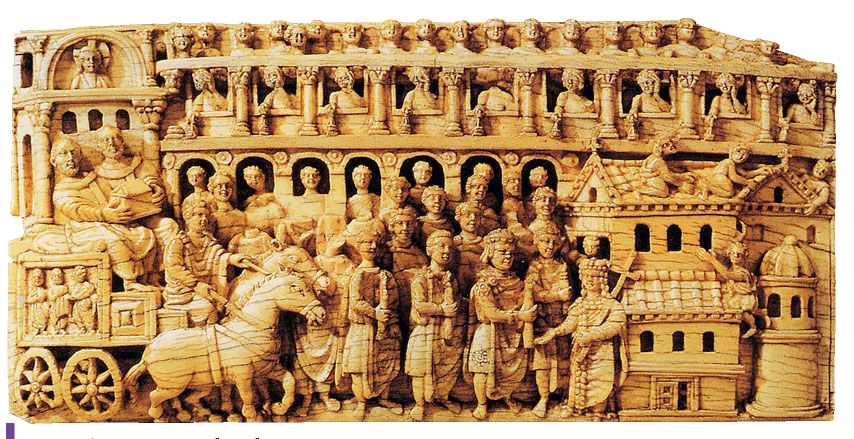
Procession to a New Church
In this sixth-century ivory carving, two men in a wagon, accompanied by a procession of people holding candles, comport a relic casket to a church nether construction. Workers are putting tiles on the church building roof. New churches oft received holy items when they were dedicated, and processions were mutual ways in which people expressed community devotion. (Cathedral
Treasury, Trier. Photograph: Ann Muenchow)
Tion, easing the conversion of pagan men and women past stressing similarities between their community and behavior and those of Chris tianity. In the same way that classically trained scholars such as Jerome and Augustine blended Greco-Roman and Christian ideas, missionaries and converts mixed pagan ideas and practices with Christian ones. Bogs and lakes sacred to Germanic gods became associated with saints, as did various aspects of ordinary life, such as traveling, planting crops, and worrying well-nigh a sick kid. Aspects of existing midwinter celebrations, which often centered on the render of the dominicus equally the days became longer, were incorporated into celebrations of Christmas. Spring rituals involving eggs and rabbits (both symbols of fertility) were added to Easter.
As well instrumental in converting pagans was the rite of reconciliation in which the sinner was able to receive God'due south forgiveness. The penitent knelt individually earlier the priest, who questioned the penitent about the sins he or she might take committed. A penance such as fasting on bread and water for a period of time or saying specific prayers was imposed as medicine for the soul. The priest and penitent were guided by manuals known as penitentials (pen-uh-TENT-shuls), which included lists of sins and the appropriate penance. Penitentials gave pagans a sense of expected behavior. The penitential organisation also encouraged the private examination of conscience and offered relief from the burden of sinful deeds.
Most religious observances continued to be community matters, however, as they had been in the aboriginal earth. People joined with family members, friends, and neighbors to celebrate baptisms and funerals, presided over by a priest. They prayed to saints or to the Virgin Mary to intercede with God, or they simply asked the saints for protection and approval. The entire village participated in processions marker saints' days or points in the agricultural year, ofttimes carrying images of saints or their relics—bones, articles of clothing, or other objects associated with the life of a saint—around the houses and fields.
Migrating Peoples
What were some of the causes of the barbarian migrations and how did they touch the regions of Europe?
The migration of peoples from one expanse to another has been a dominant and continuing feature of Western history. Mass movements of Europeans occurred in the quaternary through 6th centuries, in the 9th and tenth centuries, and in the 12th and thirteenth centuries. From the sixteenth century to the present, such movements have been most continuous, involving not just the European continent but the entire world. The causes of early migrations varied and are not thoroughly understood by scholars. Merely there is no question that the migrations profoundly affected both the regions to which peoples moved and the ones they left backside.
In surveying the world effectually them, the ancient Greeks ofttimes conceptualized things in dichotomies, or sets of opposites: low-cal/night, hot/cold, wet/dry, mind/ torso, male/female, and then on. One of their key dichotomies was Greek/non-Greek,
I penitentials Manuals for the I examination of conscience.
Relics Bones, manufactures of vesture, or other objects associated with the life of a saint.
Section Review
• St. Paul urged Christians to make their faith Catholic, meaning "universal" or "worldwide."
• Christian missionaries spread their faith throughout the Roman Empire and beyond.
• In western Europe missionaries gained influence by converting leaders; in eastern Europe Christianity spread to Moravia and Russia, bringing with it the Cyrillic alphabet and inspiring Russian literature.
• Saint Patrick brought Christianity to Ireland while the nun Bridget of Kildare and other women worked to spread it there.
• Roman and Celtic church organization differed in types of monastic life and dates of the Christian calendar, simply after an ecclesiastical council in 664, the British followed the Roman practices, tying the English language church to Rome.
• Christian missionaries achieved conversion of pagans by preaching and past assimilating existing pagan community.
• The rite of reconciliation forgave individual sins through penance and confession to a priest, yet faith continued to be more often than not a community matter.
Celts, Germans, and Huns
Barbarians A name given past the Romans to all peoples living outside the frontiers of the Roman Empire (except the Persians).
And the Greeks coined the word barbaros for those whose native language was non Greek, considering they seemed to the Greeks to be speaking nonsense syllables—bar, bar, bar. ("Bar-bar" is the Greek equivalent to "apathetic-blah" or "yada-yada.") Barbaros originally meant just not speaking Greek, but gradually it likewise implied unruly, savage, and more than archaic than the advanced civilisation of Greece. The word brought this meaning with it when it came into Latin and other European languages, with the Romans referring to those who lived beyond the northeastern boundary of Roman territory as barbarians. Migrating groups that the Romans labeled as barbarians had pressed along the Rhine-Danube borderland of the Roman Empire since most 150 c. east. (see page 109). In the third and fourth centuries, increasing pressures on the frontiers from the e and northward placed greater demands on Roman military manpower, which plague and a declining birthrate had reduced. Therefore, Roman generals recruited barbarian refugees and tribes allied with the Romans to serve in the Roman army, and some rose to the highest ranks.
As Julius Caesar avant-garde through Gaul betwixt 58 and fifty b. c.e. (come across folio 102), the largest barbaric groups he encountered were Celts (whom the Romans called Gauls) and Germans. Modern historians have tended to use the terms German and Celt in a racial sense, simply contempo research stresses that Celt and High german are linguistic terms, a Celt being a person who spoke a Celtic linguistic communication, an ancestor of the modern Gaelic or Breton language, and a German language one who spoke a Germanic language, an antecedent of modern German language, Dutch, Danish, Swedish, or Norwegian.
Celts and Germans were similar to 1 another in many ways. In the get-go century c. e., the Celts lived east of the Rhine River in an area bounded by the Main Valley and extending westward to the Somme (sawm) River. Germans were more than numerous along the North and Baltic Seas. Both Germans and Celts used wheeled plows and a three-field system of crop rotation. Before the introduction of Christianity, both Celtic and Germanic peoples were polytheistic, with hundreds of gods and goddesses with specialized functions whose celebrations were often linked to points in the yearly agronomical bike. Worship was often outdoors at sacred springs, groves, or lakes.
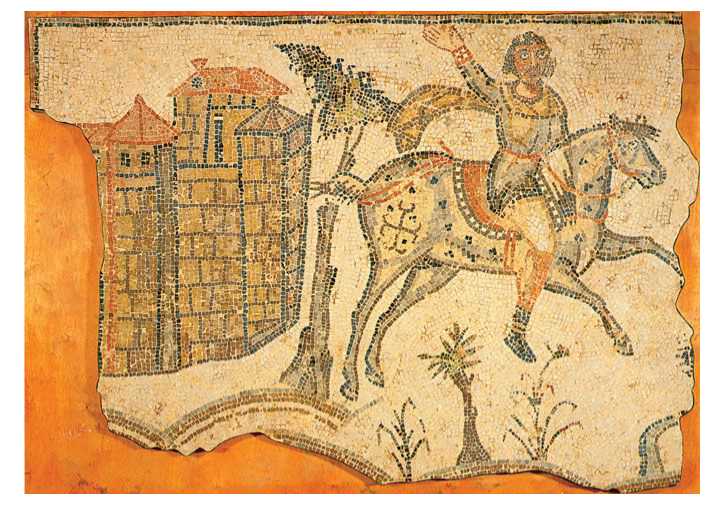
Vandal Landowner
In this mosaic, a Vandal landowner rides out from his Roman-manner house. His clothing-Roman brusk tunic, cloak, and sandals-reflects the style some Celtic and Germanic tribes accepted Roman lifestyles, though his beard is more typical of barbarian men's fashion.
(Courtesy of the Trustees of the British Museum)
The Celts had adult iron manufacturing, using shaft furnaces every bit sophisticated as those of the Romans to produce iron swords and spears. Celtic priests, chosen druids (DROO-idz), had legal and educational as well as religious functions, orally passing downward laws and traditions from generation to generation. Bards singing poems and ballads likewise passed downwardly stories of heroes and gods, which were written down much later. Celtic peoples conquered by the Romans often assimilated to Roman means, adapting the Latin language and other aspects of Roman culture. By the fourth century c. e., under pressure level from Germanic groups, the Celts had moved westward, settling in Brittany (mod northwestern France) and throughout the British Isles (Engl and, Wales, Scotland, and Republic of ireland). The Picts of Scotland as well as the Welsh, Britons, and Irish were peoples of Celtic descent. (See Map 7.3.)
MAPPING THE PAST
MAP 7.3 The Barbarian Migrations
This map shows the migrations of diverse barbarian groups in late antiquity and can exist used to respond the post-obit questions: [1] The map has no political boundaries. What does this suggest about the impact of barbarian migrations on political structures? [two] Homo migration is caused by a combination of push factors (circumstances that lead people to exit a place) and pull factors (things that attract people to a new location). Based on the information in this and earlier capacity, what push and pull factors might have shaped the migration patterns yous see on the map? [3] The movements of barbarian peoples used to be labeled "invasions" and are now usually described as "migrations." How practice the dates on the map support the newer agreement of these movements?

The migrations of the Germanic peoples were important in the political and social transformations of late antiquity. Many modern scholars take tried to explain who the Germans were and why they migrated. The present consensus, based on the study of linguistic and archaeological evidence, is that at that place was not one but rather many Germanic peoples with very different cultural traditions. The largest Germanic tribe, the Goths, was a polyethnic grouping of nearly one hundred thousand people, including maybe fifteen thousand to twenty thousand warriors. The tribe was supplemented by slaves, who, considering of their desperate situation under Roman rule, joined the Goths during their migrations.3
Why did the Germans migrate? Similar the Celts, in part they were pushed by groups living further eastward, particularly by the Huns from primal Asia in the fourth and 5th centuries. In part, they were searching for more regular supplies of nutrient, better farmland, and a warmer climate. Conflicts within and among Germanic groups besides led to war and disruption, which motivated groups to move. Franks fought Alemanni (al-uh-Homo-ahy) in Gaul; Visigoths fought Vandals in the Iberian Peninsula and across North Africa; and Angles and Saxons fought Celtic-speaking Britons in England.
All these factors can be seen in the movement of the Visigoths, 1 of the Germanic tribes, from an surface area north of the Black Sea southeastward into the Roman Empire. Pressured past defeat in battle, starvation, and the move of the Huns, the Visigoths petitioned the emperor Valens to admit them to the empire. Seeing in the hordes of warriors the solution to his manpower trouble, Valens agreed. Once the Visigoths were within the empire, Roman authorities exploited their hunger by forcing them to sell their own people as slaves in exchange for dog flesh: "the going rate was ane dog for i Goth." Even so, the Visigoths sought peace. Fritigern offered himself as a friend and marry of Rome in substitution for the province of Thrace—land, crops, and livestock. Confident of victory over a considerably smaller army, Valens and his quango chose to battle the Visigoths and lost.
Alaric I'southward invasion of Italy and sack of Rome in 410 represents the culmination of hostility between the Visigoths and the Romans. The Goths burned and looted the city for three days, which caused many Romans to wonder whether God had deserted them. This led the regal authorities to pull its troops from the British Isles and many areas northward of the Alps, leaving these northern areas more than vulnerable and open to migrating groups. A year later on Alaric died, and his successor led his people into southwestern Gaul.4 Establishing their headquarters at Toulouse, they exercised a weak domination over Kingdom of spain until a Muslim victory at Guadalete in 711 ended Visigothic rule.
Ane pregnant cistron in Germanic migration was pressure level from nomadic steppe peoples from central Asia. This included the Alans, Avars, Bulghars, Kha-zars, and nearly prominently the Huns, who attacked the Black Sea area and the Eastern Roman Empire beginning in the quaternary century. Under the leadership of their warrior-king Attila, the Huns swept into central Europe in 451, attacking Roman settlements in the Balkans and Germanic settlements along the Danube and Rhine Rivers. Afterwards Attila turned his ground forces southward and crossed the Alps into Italy, a papal delegation, including Pope Leo I himself, asked him not to attack Rome. Though papal diplomacy was later credited with stopping the advance of the Huns, a plague that spread amid Hunnic troops and their dwindling food supplies were probably much more important. The Huns retreated from Italy, and within a year Attila was dead. Later leaders were non equally constructive, and the Huns were never again an important factor in European history. Their conquests had slowed downwardly the movements of various Germanic groups, however, allowing barbarian peoples to absorb more of Roman culture as they picked the Western Roman Empire apart.
Betwixt 450 and 565, the Germans established a Germanic Kingdoms Number of kingdoms, but none—other than the Frankish kingdom-lasted very long. The Germanic kingdoms did not have definite geographical boundaries, and their locations are judge. The Vandals, whose subversive ways are commemorated in the word vandal, settled in North Africa. In northern and western Europe in the 6th century, the Burgundians (ber-GUHN-dee-uhns) ruled over lands roughly circumscribed by the erstwhile Roman army camps at Lyons, Besangon (buh-zahn-SAWN), Geneva, and Autun.
In northern Italy the Ostrogothic king Theodoric (r. 471-526) established his residence at Ravenna and gradually won control of all Italy, Sicily, and the territory north and eastward of the upper Adriatic. Although attached to the customs of his people, Theodoric pursued a policy of assimilation between Germans and Romans. He maintained close relations with the emperor at Constantinople and attracted able scholars such every bit Cassiodorus (kas-ee-uh-DAWR-uhs) (run across page 212) to his administration. Theodoric'south accomplishments were pregnant, simply his assistants fell apart after his decease.
Salic Law A law code issued by Salian Franks that provides u.s.a. with the earliest clarification of Germanic community.
Merovingian The Frankish dynasty named later its founder, Merowig, a man of mythical origins.
The kingdom established past the Franks in the sixth century, in spite of subsequently civil wars, proved to exist the near powerful and indelible of all the Germanic kingdoms. In the fourth and fifth centuries, they settled within the empire and allied with the Romans, some attaining high military and ceremonious positions. In the sixth century ane group, the Salian (SAY-lee-uhn) Franks, issued a law code called the Salic (SAL-ik) Police force, the primeval clarification of Germanic customs. Chlodio (fifth century) is the first member of the Frankish dynasty for whom evidence survives. According to legend, Chlodio'south married woman went swimming, encountered a sea monster, and conceived Merowig. The Franks believed that Merowig, a man of supernatural origins, founded their ruling dynasty, which was thus called Merovingian (mer-uh-VIN-jee-uhn).
The reign of Clovis (ca. 481-511) marks the decisive flow in the evolution of the Franks equally a unified people. Through military campaigns, Clovis acquired the central provinces of Roman Gaul. Clovis's conversion to Christianity besides brought him the crucial back up of the papacy and of the bishops of Gaul. (Come across the characteristic "Listening to the Past: The Conversion of Clovis" on pages 160161.) The next ii centuries witnessed the steady absorption of Franks and Gallo-Romans, as many Franks adopted the Latin language and Roman ways, and Gallo-Romans copied Frankish customs and Frankish personal names. These centuries also saw Frankish conquering of the Burgundian kingdom and of territory held by the Goths in Provence.5
The isle of United kingdom of great britain and northern ireland was populated by various Celtic-Anglo-Saxon England Speaking tribes when it was conquered by Rome during the reign of Claudius. During the first 4 centuries c. e., it shared fully in the life of the Roman Empire. Towns were planned in the Roman manner, with temples, public baths, theaters, and amphitheaters. In the countryside large manors controlled the surrounding lands. Roman merchants brought Eastern luxury appurtenances and Eastern religions—including Christianity—into Britain. The Romans suppressed the Celtic chieftains, and a military machine elite governed. In the course of the second and third centuries, many Celts alloyed to Roman culture, becoming Roman citizens and joining the Roman ground forces.
When imperial troops withdrew from Britain in order to defend Rome from the Visigoths, the Picts from Scotland and the Scots from Ireland invaded British
Section Review
"Barbaras," the Greek word that is the origin of "barbarian" originally meant not speaking Greek, but subsequently unsaid savage and primitive.
Celts and Germans were similar in their polytheism and origins only the Celts moved westward under pressure from Germanic groups.
Germanic peoples migrated to search for better food and climate and considering of conflicts with other groups, such every bit the Huns.
The longest-lasting of the Germanic kingdoms was the Frankish kingdom under Clovis, who settled within Roman Gaul and assimilated with the Gallo-Romans.
The Germanic Anglo-Saxons in Britain destroyed Roman culture as they fought among themselves and with the Britons to the westward, earlier Viking invasions united them nether King Alfred.
Celtic mythology and the legend of King Arthur may correspond Celtic hostility toward Anglo-Saxon influence.
Celtic territory. According to the eighth-century historian Bede (beed) (see page 181), the Celtic male monarch Vortigern invited the Saxons from Denmark to assistance him against his rivals in Britain. Saxons and other Germanic tribes from modernistic-24-hour interval Norway, Sweden, and Denmark turned from assistance to conquest, attacking in a striking-and-run fashion. Their goal was plunder, and at first their invasions led to no permanent settlements. As more than Germanic peoples arrived, however, they took over the best lands and eventually conquered about of Britain. Some Britons fled to Wales and the westernmost parts of England, northward toward Scotland, and beyond the English Aqueduct to Brittany. Others remained and somewhen intermarried with Germanic peoples.
Historians have labeled the menstruation 500 to 1066, the years of the Norman Conquest, every bit the "Anglo-Saxon" period, after the two largest Germanic tribes, the Angles and the Saxons. The Germanic tribes destroyed Roman culture in Britain. Christ ianity disappeared, large urban buildings were allowed to autumn apart, and tribal custom superseded Roman law.
Anglo-Saxon England was divided along ethnic and political lines. The Germanic kingdoms in the south, east, and middle were opposed past the Britons in the west, who wanted to get rid of the invaders. The Anglo-Saxon kingdoms also fought amidst themselves, causing boundaries to shift constantly. Finally, in the 9th century, under pressure from the Viking invasions, the Celtic Britons and the Germanic Anglo-Saxons were molded together under the leadership of King Alfred of Wessex (WES-iks) (r. 871-899).
The Anglo-Saxon invasion gave rising to a rich body of Celtic mythology, specially legends about the Celtic King Arthur, who beginning appeared in Welsh verse in the sixth century and afterwards in histories, epics, and saints' lives. Nigh scholars encounter Arthur as a composite figure who evolved over the centuries in songs and stories. According to these texts, Arthur was the illegitimate son of the king of Britain whose purple parentage was revealed when he successfully drew the invincible sword Excalibur from a stone. Arthur won recognition as rex and used Excalibur to win many battles. His quests included a search for the Holy Grail, the dish supposedly used by Jesus at the Final Supper, which was said to accept miraculous powers. Arthur held his court at Camelot, where his knights were seated at the Round Table, where all were equal. Those knights included Sir Tristan, Sir Galahad, Sir Percival (Parsifal), and Sir Lancelot; Lancelot's romance with Arthur's wife Guinevere (GWIN-uh-veer) led to the stop of the Arthurian kingdom. In their earliest class as Welsh poems, the Arthurian legends may represent Celtic hostility to Anglo-Saxon invaders, just they after came to be more of import equally representations of the ideal of medieval knightly chivalry and every bit great stories whose retelling has continued to the present.
Barbaric Social club
What patterns of social, political, and economic life characterized barbaric society?
Germanic and Celtic society had originated in the northern parts of central and western Europe and the southern regions of Scandinavia during the Iron Age (800-500 b. c.e.). After Germanic kingdoms replaced the Roman Empire every bit the chief political structure throughout much of Europe, barbaric customs and traditions formed the basis of European social club for centuries.
Runic (ROO-nik) Inscriptions
This eighth-century breast made of whalebone depicts warriors, other human being figures, and a equus caballus, with a border of runic letters. This chest tells a story in both pictures and words. The runes are one of the varieties from the British Isles, from a fourth dimension and place in which the Latin alphabet was known every bit well. Runes and Latin letters were used side-by-side in some parts of northern Europe for centuries. (Erich tessing/Art Resource, NY)
Kinship, Custom, and Class
Runic alphabet Writings that help to give a more accurate picture of b
Source: https://www.worldhistory.biz/modern-history/81297-theodora-of-constantinople.html
Posted by: spraguethicamewyn.blogspot.com
0 Response to "What Was Theodoras Favorite Animal At The Circus"
Post a Comment